
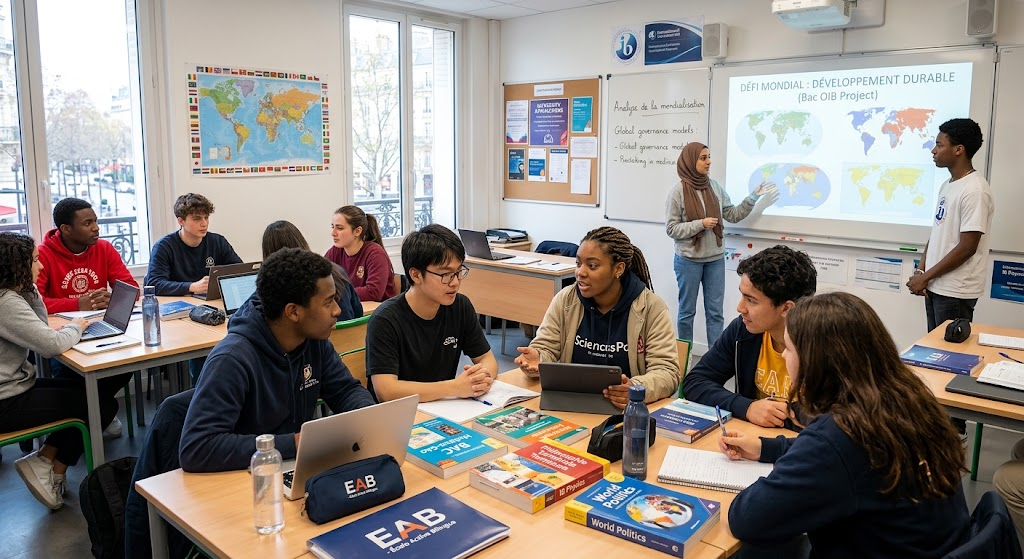
Assessment in the International Baccalaureate (IB) helps educators understand student progress, identify learning needs, and develop essential academic skills. Across its four programmes, the IB uses different assessment methods adapted to students’ ages, learning objectives, and levels of independence. These approaches combine ongoing feedback with formal tasks, allowing learners to demonstrate their knowledge, apply concepts, and reflect on their development.
Assessment Methods in the Primary Years Programme
The Primary Years Programme (PYP) serves younger learners and emphasises inquiry, conceptual understanding, and the development of transferable skills. Assessment is integrated into everyday learning rather than limited to formal examinations.
Using Formative Assessment in Primary Education
Formative assessment helps teachers identify what students understand while learning is taking place. It also enables educators to adjust lessons and provide targeted support.
Common methods include:
-
Classroom observations: Teachers monitor participation, collaboration, communication, and problem-solving.
-
Learning portfolios: Students collect work samples that demonstrate progress over time.
-
Teacher feedback: Verbal and written comments help learners recognise strengths and areas for improvement.
-
Self-assessment: Students reflect on their learning and identify personal goals.
-
Peer assessment: Classmates exchange feedback and practise evaluating work constructively.
At the end of the PYP, students typically complete a PYP exhibition, an extended inquiry project through which they investigate an issue, develop ideas, and present their learning. This experience encourages research, collaboration, and independent thinking.
Assessment Methods in the Middle Years Programme
The Middle Years Programme (MYP) builds on earlier learning by encouraging students to apply knowledge across subjects and connect academic concepts with real-world contexts. Assessment focuses on clearly defined subject-specific criteria and the development of analytical skills.
Applying Criterion-Based Assessment
MYP teachers assess student work against established criteria rather than relying exclusively on comparisons between classmates. This approach helps learners understand what successful performance requires.
Typical assessment tasks include:
-
Essays and written assignments: Students demonstrate subject knowledge, organise arguments, and communicate ideas.
-
Practical investigations: Science and other subjects may involve experiments, data collection, and evidence-based conclusions.
-
Presentations and performances: Learners communicate understanding through oral presentations, creative work, or practical demonstrations.
-
Projects and portfolios: Students document their research, planning, progress, and final outcomes.
The MYP personal project, usually completed in the final year of the programme, allows students to explore an individual interest and demonstrate independent learning. Some schools also offer optional MYP eAssessments, which may contribute to externally validated programme results and the IB MYP certificate.
Assessment Methods in the Diploma Programme
The Diploma Programme (DP) places greater emphasis on subject mastery, academic independence, research, and preparation for higher education. Its assessment framework combines internal assessment with externally assessed examinations and coursework.
Combining Internal and External Assessment
Internal assessment allows students to demonstrate their understanding through tasks completed during the course, with teachers assessing the work according to IB criteria. The IB may moderate or review these assessments to support consistency across schools.
Common methods include:
-
Written examinations: Assess subject knowledge, analytical reasoning, and the ability to apply concepts under timed conditions.
-
Internal assessments: Depending on the subject, these may include investigations, oral commentaries, laboratory reports, or mathematical explorations.
-
Extended Essay: Students undertake independent research and produce an academic essay on a chosen topic.
-
Theory of Knowledge (TOK): Students examine how knowledge is constructed and justified through prescribed tasks, including an exhibition and an essay.
-
Creative, Activity, Service (CAS): Students document participation, reflection, and development through meaningful experiences rather than receiving a conventional subject grade.
The combination of assessment formats provides a broader picture of student achievement. It also requires learners to manage deadlines, evaluate evidence, and communicate complex ideas effectively.
Assessment Methods in the Career-related Programme
The Career-related Programme (CP) combines academic study with career-related learning. Its assessment methods reflect this practical orientation while maintaining links to the IB’s educational principles.
Evaluating Academic and Professional Development
CP students complete relevant DP courses alongside career-related studies. Their assessment therefore depends partly on the requirements of the selected academic subjects and career-related qualification.
Important assessment components include:
-
DP course assessments: Students complete the examinations and internal assessment tasks associated with their selected subjects.
-
Reflective Project: Learners investigate an ethical issue connected to their career-related studies and present their findings in an appropriate format.
-
Language development portfolio: Students document their language learning, experiences, and progress.
-
Service learning: Learners participate in activities that address identified needs and reflect on their experiences.
-
Personal and professional skills: Students develop communication, collaboration, ethical reasoning, and intercultural understanding.
These components help students connect academic learning with workplace expectations and future professional pathways.
Understanding the Purpose of Different Assessment Methods
Although assessment varies across IB programmes, several principles remain consistent. Teachers use evidence of learning to guide instruction, while students develop the ability to evaluate their own progress and respond to feedback.
Matching Assessment With Learning Objectives
The most effective assessment method depends on the skills and knowledge being evaluated. Different formats reveal different aspects of student learning.
For example:
-
Knowledge-based tasks measure understanding of concepts and factual information.
-
Research assignments evaluate inquiry, source analysis, and evidence-based reasoning.
-
Practical tasks demonstrate the application of skills in authentic or simulated situations.
-
Reflective activities encourage students to recognise progress and identify future learning goals.
A balanced assessment approach avoids relying on a single measure of achievement. Instead, it combines multiple forms of evidence to provide a more comprehensive understanding of student development.
Supporting Continuous Student Progress
Assessment across the IB programmes evolves from guided observation and feedback in primary education to increasingly independent research, formal examinations, and career-related evaluation in later stages. Each approach serves a distinct purpose while supporting the development of knowledgeable, reflective, and capable learners.
Understanding these assessment methods helps students and families prepare for programme expectations. When assessment criteria are transparent and feedback is constructive, learners can identify areas for improvement, build confidence, and take greater responsibility for their academic progress.