Make Songs Part of Everyday Language Practice
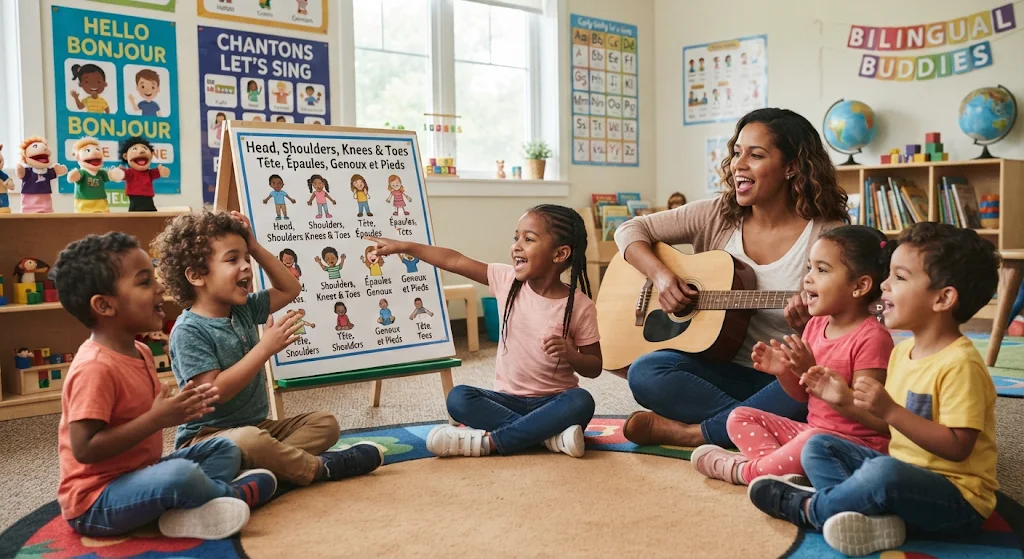
Songs help young children become familiar with the sounds, rhythms and pronunciation patterns of two languages, supporting their bilingual development. Their melodies and repeated lyrics make new expressions easier to remember, while movements and gestures provide visual clues that support understanding.
Music can be introduced through short, enjoyable activities throughout the day. Simple songs about colours, animals, numbers, greetings or daily routines allow children to hear useful vocabulary in context. Repeating the same songs regularly also helps them recognise familiar words and gradually join in.
Select Songs That Encourage Learning
The most effective songs for early bilingual learning have simple lyrics, clear pronunciation and repetitive structures. Educators and parents can choose music that matches children’s ages, interests and language abilities.
Several activities can make musical experiences more interactive:
-
Action songs: Encourage children to follow instructions through movements, such as clapping, jumping or touching different body parts.
-
Counting songs: Introduce numbers and basic mathematical vocabulary in both languages.
-
Animal songs: Help children associate animal names with sounds, pictures and movements.
-
Greeting songs: Reinforce everyday expressions and encourage children to communicate with others.
-
Traditional songs: Introduce cultural references, familiar celebrations and musical styles from different communities.
It is helpful to alternate between songs in each language rather than concentrating exclusively on one. Children can also listen to the same melody with different lyrics, allowing them to recognise familiar patterns while discovering new vocabulary.
Encourage Communication Through Games
Games create natural opportunities for children to practise speaking, listening and understanding. Unlike formal language exercises, playful activities encourage participation without putting pressure on young learners to produce perfect sentences.
Simple games can introduce vocabulary, reinforce familiar expressions and help children understand instructions in different linguistic contexts. They also encourage cooperation, turn-taking and social interaction.
Introduce Simple Bilingual Games
Activities should remain accessible and enjoyable, with rules adapted to children’s developmental stages. A few examples can easily become part of everyday learning:
-
Picture matching: Children match images with corresponding words in either language, reinforcing vocabulary through visual associations.
-
Object hunts: Educators name an object in one language and invite children to find it around the classroom.
-
Memory games: Players turn over cards and identify matching pictures using vocabulary from both languages.
-
Role-playing: Pretending to run a shop, prepare a meal or visit a doctor encourages children to use everyday expressions.
-
Simon Says: Following instructions in different languages helps develop listening skills and understanding.
Repeating these activities with small variations keeps children interested while reinforcing previously learned expressions. Adults can introduce new words gradually and encourage children to use them during play.
Combine Activities for Meaningful Progress
Storytelling, songs and games are most effective when they complement one another. Combining these experiences allows children to encounter the same vocabulary in different situations, making it easier to recognise, remember and eventually use new expressions.
For example, a story about farm animals can introduce their names and characteristics. Children can then sing an animal-themed song before playing a matching game with corresponding pictures. This progression reinforces familiar vocabulary through listening, movement and interaction.
Create a Supportive Learning Environment
Consistency and encouragement are essential throughout early bilingual development. Children acquire language at different speeds, and some may initially understand more than they can express. Adults should recognise these differences without comparing children’s abilities or forcing them to speak.
A supportive environment can be encouraged through a few simple practices:
-
Maintain regular exposure: Include both languages in everyday activities rather than limiting them to specific lessons.
-
Encourage participation: Accept gestures, short answers and attempts to communicate as meaningful steps.
-
Model clear language: Use simple sentences and repeat unfamiliar expressions naturally.
-
Celebrate progress: Recognise new words, improved pronunciation and growing confidence.
-
Respect individual rhythms: Allow children enough time to understand and respond without unnecessary pressure.
Communication between families and educators can also strengthen learning. Sharing familiar songs, stories and expressions helps create continuity between home and educational settings.
Make Bilingual Learning Enjoyable and Consistent
Early bilingual learning develops through repeated exposure, meaningful interaction and positive experiences. Storytelling builds understanding, songs introduce rhythm and pronunciation, while games encourage children to use language actively.
When these activities are integrated into everyday routines, children can gradually develop vocabulary, listening skills and confidence in both languages. The objective is not to achieve immediate fluency but to create an environment where communication feels natural, enjoyable and relevant to their daily experiences.